
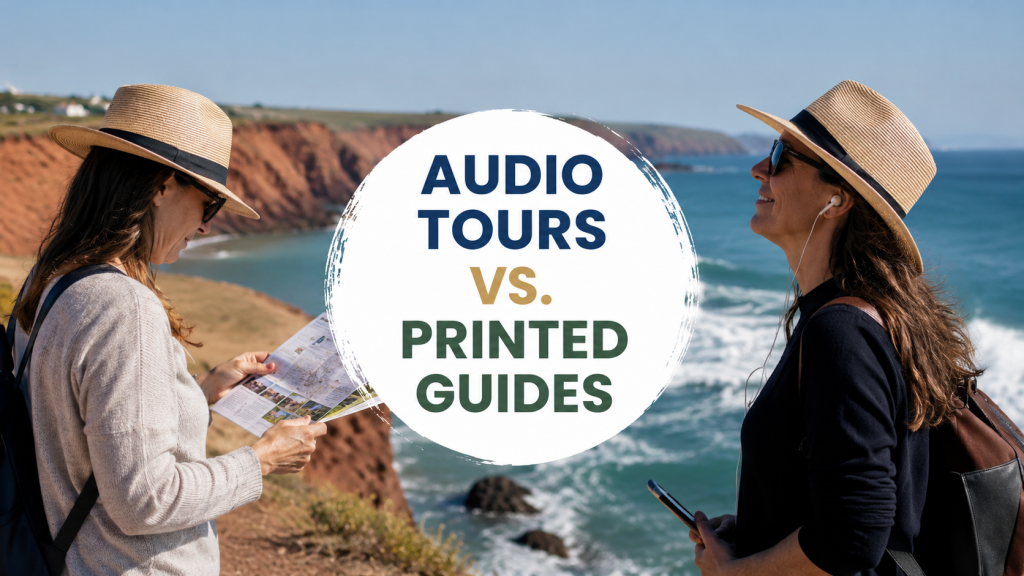
If you had asked me this question ten years ago, I might have surprised you with my answer.
I’m a printed-paper kind of person. I still prefer reading a physical book over an e-reader. I like newspapers. I print recipes. When I need to find information again, I often find it easier to flip through paper than search through my phone.
So when I started developing self-guided tours for Tour My Town PEI, you might think I would have created a printed guidebook.
Instead, I chose audio tours.
After creating my own tours and using audio tours throughout Portugal, Ireland, London, and the United States, I’ve become convinced that for most travellers, audio tours provide a better experience than traditional printed guides.
Why I Chose Audio Tours Instead of Printed Guides
When I created my tours, my goal was simple: I wanted visitors to feel as though I was personally showing them around.
A printed guide can provide information, but it can’t recreate the experience of having a local guide beside you sharing stories as you explore.
With an audio tour, visitors don’t have to stop and read text, study maps, or constantly look down at a guidebook. They can focus on what they came to see.
Whether they’re strolling through Charlottetown’s historic streets or driving along the coast near North Cape, they can simply listen while taking in the scenery around them.
I wanted visitors to spend their time looking at the places they travelled to see, not looking down at a guide trying to figure out what they were supposed to be seeing.
My Experience Using Printed Guides
I’ve used plenty of printed guides while travelling.
One example that stands out was visiting Rome. I would arrive at a landmark such as the Pantheon, the Spanish Steps, or the Trevi Fountain and open my guidebook.
The guide would provide a few interesting facts, but I found myself constantly switching between reading and sightseeing.
I’d read a paragraph.
Then I’d look around for the feature the guide was describing.
Then I’d go back and read some more.
Then I’d look around again.
It worked, but it felt disconnected.
I was spending part of my time studying the guide instead of fully experiencing the place.
Why Audio Tours Feel Different
When I use an audio tour, the experience is much more natural.
As I walk or drive, the stories unfold through my headphones while I look around and absorb what’s happening around me.
I don’t need to stop and read.
I don’t need to figure out where I am on a map.
I don’t need to wonder if I’ve missed something important.
The tour guides me along the route, and many modern audio tour apps will even alert you if you’ve wandered off course and help you get back on track.
The result feels much closer to having a knowledgeable local beside you.
The Flexibility Is Hard to Beat
One of my favourite things about audio tours is the flexibility.
When I travel, I don’t always want to build my day around a scheduled tour that starts at a specific time on a specific day.
With an audio tour, I can start whenever I want.
If I want to stop for lunch, I stop.
If I find an interesting shop, I can browse.
If I want to spend extra time taking photographs, nobody is waiting for me.
The tour simply waits until I’m ready to continue.
Several visitors who have taken my tours have mentioned this flexibility as one of the things they enjoyed most.
One reviewer wrote:
“Thanks so much for putting this together! It was perfect for our interest in seeing significant places, learning history, but also having the freedom to go and see other places for a bit, too.”
That freedom is difficult to replicate with either a guided group tour or a printed guide.
Stories Matter Just as Much as Facts
Most printed guides do a good job providing facts.
They’ll tell you when a building was constructed, who designed it, or why it’s historically significant.
Those facts are important.
But what I enjoy most when travelling are the stories.
Stories help bring a place to life.
They reveal local folklore, colourful characters, community traditions, and the little details that don’t always make it into guidebooks.
When I create a tour, I try to include both.
Visitors learn the history, but they also hear the stories that locals tell.
That storytelling element is one of the biggest advantages of audio tours.
You aren’t just receiving information. You’re sharing an experience.
What Visitors Have Told Me
One of the most rewarding parts of creating audio tours has been hearing from visitors afterward.
Recently, a couple from California completed my Tignish and North Cape driving tour and sent me a message that made my day.
They wrote:
“My husband and I did your driving tour of Tignish today. It was excellent. You did such a great job putting it together and are a great narrator. We plan to purchase your Charlottetown tour when we get there later this week. Thanks again for your hospitality and showing us around your home town.”
What struck me wasn’t just that they enjoyed the tour.
It was that they felt as though they had been personally shown around by someone local.
Other reviews have mentioned:
- The freedom to explore at their own pace.
- Learning from a local perspective.
- Enjoying stories that added personality and colour to the experience.
- Being able to stop and restart whenever they wanted.
- Having a tour that worked smoothly while they explored.
For me, that’s exactly what I hoped to achieve.
When Printed Guides Still Make Sense
Despite everything I’ve said, I don’t believe printed guides are obsolete.
In some situations, they may actually be the better choice.
A printed guide might be right for you if:
- You don’t use a smartphone.
- You’re uncomfortable with mobile apps.
- You enjoy highlighting, bookmarking, and making notes.
- You collect travel guidebooks as souvenirs.
- You simply prefer reading to listening.
There are also practical considerations.
For example, cellular coverage can be spotty along parts of PEI’s coastline. That’s why I always recommend downloading an audio tour before leaving your hotel or any area with reliable internet access.
And yes, some visitors may find it easier to read than listen to my Western PEI accent!
There’s nothing wrong with that.
Different travellers have different preferences.
So, Are Audio Tours Better Than Printed Guides?
For most travellers, I believe the answer is yes.
Audio tours allow you to keep your eyes on the destination instead of the guidebook.
They offer the flexibility to explore at your own pace.
They feel more personal.
They often include stories and local perspectives that go beyond basic facts.
Most importantly, they allow you to experience a place while learning about it, rather than alternating between reading and sightseeing.
That said, printed guides still have their place, particularly for travellers who prefer paper or aren’t comfortable with technology.
But if a friend asked me what I’d recommend for exploring Prince Edward Island—or almost anywhere else in the world—I would tell them to download an audio tour, put in their headphones, and start exploring.
After all, you travelled all that way to see the destination.
Why spend the trip looking down at a guidebook?